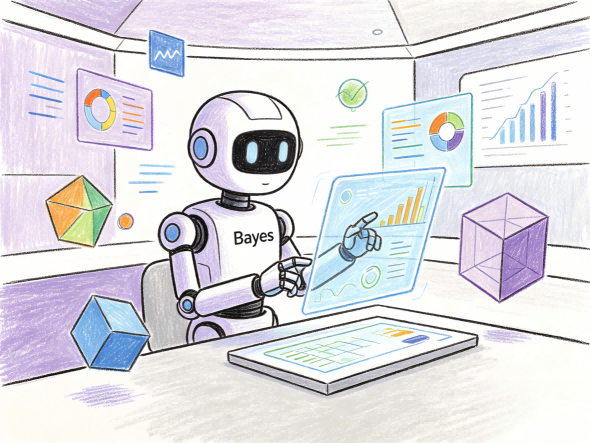
From Deep Analysis to Premium Slides, Agentized.
Over the past decade, companies have become extraordinarily good at collecting data. Every workflow leaves a trail behind it: customer behavior, revenue movement, operational metrics, marketing performance, product usage, retention curves. Data is everywhere, and in theory, answers should be easier to find than ever before.
Yet inside most organizations, the opposite often feels true.
The challenge today is rarely access to data. It’s access to understanding.
Teams don’t struggle because there isn’t enough information. They struggle because turning information into insight still requires too many steps, too many tools, and too much specialized knowledge. A simple business question often expands into an unexpectedly complex workflow: export data from one system, clean missing values in another, write queries, build charts, interpret patterns, then reorganize everything into slides someone can actually present. By the time the answer is ready, the original question may already have changed.
This friction has quietly become part of how modern work operates. We’ve accepted that analysis is slow. That asking deeper questions requires technical expertise. That getting from raw data to a clear recommendation means depending on analysts, data teams, or lengthy reporting cycles.
But we don’t think that assumption should hold anymore.
Across every company, there are people constantly making decisions from incomplete information. Operators deciding how to allocate resources. Product teams trying to understand shifts in user behavior. Marketers interpreting campaign performance. Founders preparing for board meetings. Managers trying to explain what changed and what happens next. Their need is not necessarily for more dashboards or more tooling. Their need is clarity.
BayesLab was created to close the distance between a question and an answer.
When someone uploads raw data into BayesLab, they’re not just asking for charts. They’re asking the system to reason through the data with them. The platform cleans and structures messy inputs, performs analysis, surfaces patterns, identifies anomalies, and organizes findings into a coherent narrative. Visualizations, key takeaways, recommended next steps, and presentation-ready reports emerge from the same workflow rather than from disconnected tools stitched together manually.
What matters to us is not simply speed, though speed matters. It’s that the analytical process becomes continuous and complete.
Many AI products today focus on individual moments inside analysis. Some help write SQL. Some generate dashboards. Some summarize a chart after it already exists. Useful as these tools can be, they often operate as isolated assistants added onto an already fragmented workflow.
Our view is different. We believe the workflow itself is what needs redesigning.
At BayesLab, analysis is treated as an end-to-end system. Schema understanding, data cleaning, exploratory analysis, root cause investigation, prediction, chart generation, storytelling, reporting, and dashboard output are not separate tasks passed between tools. They are connected layers of a single analytical artifact. Each stage informs the next, and each output remains reusable, traceable, and reproducible.
This becomes especially powerful when working with ambiguity, which is where most real-world analysis begins.
In practice, people rarely arrive with perfectly structured questions and clean datasets. More often they arrive with uncertainty: a spreadsheet exported from several systems, inconsistent column names, incomplete records, and a broad question like “Why did growth slow in this segment?” or “What changed last quarter?” Traditional tools expect the user to translate that uncertainty into a structured workflow before analysis can begin. BayesLab is built to work in the opposite direction. It starts with imperfect inputs and vague intent, then builds toward structured reasoning.
That allows a simple CSV file to evolve into a multi-step analytical investigation: dimensional exploration, trend decomposition, root cause analysis, scenario modeling, forecasting, or prediction. Just as importantly, it allows the results to be communicated clearly enough for others to act on them.
This last part is often underestimated.
Analysis does not end when the computation is complete. It ends when understanding is shared.
Inside most teams, valuable insights frequently remain trapped in notebooks, spreadsheets, or dashboards because the final translation into a communicable story still requires manual effort. Numbers alone rarely drive decisions. People move when evidence is paired with context, narrative, and clarity.
That is why BayesLab was designed not only to produce analysis, but to produce communication-ready analysis. Reports are generated with presentation in mind from the beginning. Visuals are structured for readability. Insights are organized as narratives rather than disconnected observations. Outputs are built to move naturally into reviews, strategy meetings, executive discussions, or customer-facing conversations without needing to be rebuilt elsewhere.
Another principle that shaped BayesLab is reproducibility.
Business analysis is rarely a one-time event. Teams revisit the same questions every week, month, or quarter, often rebuilding the exact same workflow from scratch with updated data. This repetition consumes enormous time while introducing inconsistency at every iteration.
BayesLab allows the analytical workflow itself to persist. Once an analysis is complete, it can be rerun instantly against new data using the same logic, same structure, and same narrative framework. New inputs produce refreshed outputs without requiring the work to be recreated manually. This makes insight not only faster, but repeatable.
We think this shift matters because data itself is no longer the bottleneck.
The real bottleneck is interpretation.
And increasingly, the gap between data and interpretation is where organizations either move quickly or fall behind.
The future of analytics will not be defined by who has access to the most dashboards, or who can write the most complex SQL queries. It will be defined by who can ask better questions, iterate faster, and turn information into decisions with the least friction.
AI creates an opportunity to fundamentally change that equation.
Not by replacing human judgment, but by extending it. Not by generating more noise around the data, but by handling the operational burden between the raw inputs and the strategic conversation. When the mechanical parts of analysis become autonomous, people can spend more time interpreting outcomes, challenging assumptions, and making decisions.
That is the future we imagine with BayesLab.
A future where deep analysis feels as accessible as asking a question. Where messy data doesn’t slow teams down. Where insights are reproducible, presentable, and immediately actionable. And where analytical thinking is no longer limited to analysts, but available to anyone responsible for moving a business forward.
We built BayesLab for that future. And we believe it’s only the beginning.
Try Bayeslab for Free and experience Agentic Data Analysis today.